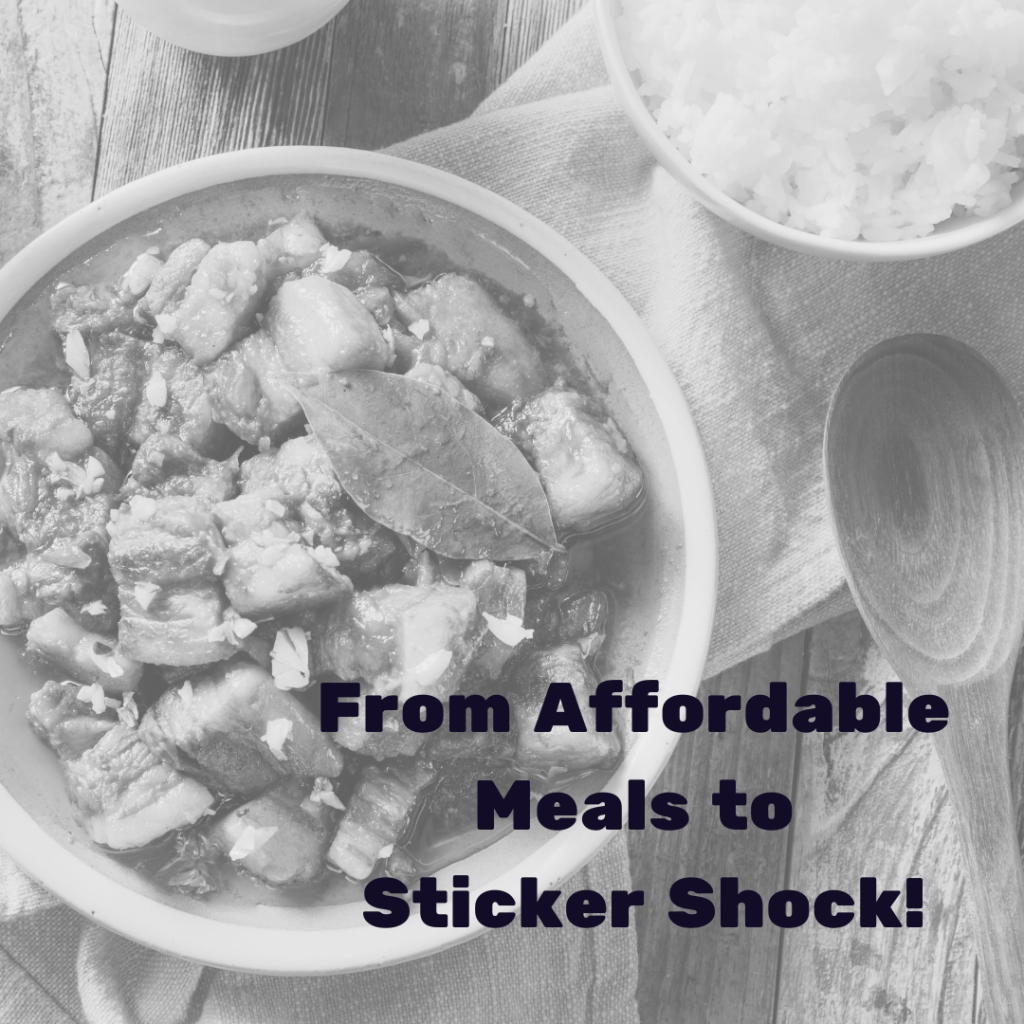
How quickly things have changed? Recently, social media went abuzz with the shocking revelation of a popular combo meal at McDonald’s costing a whopping $16. It left many cringing at the inflated prices we’re encountering these days. Little did I know, I would experience my own version of sticker shock at one of my favorite food spots – a humble Filipino Turo Turo in my neighborhood.
For the uninitiated, a Filipino Turo Turo is a local eatery where an array of pre-cooked dishes is displayed for customers to choose from. Think of it as the Filipino version of Panda Express, with a mouth-watering selection ranging from Chicken Adobo to Kare Kare to Sinigang. These were the comfort foods of my childhood, and not too long ago, a hearty meal would set me back a reasonable $8 – $10.
However, on a recent visit to my usual Turo Turo, I was greeted not only by the aroma of familiar delicacies but also by the inflated prices of a combo meal at $18.49. As a small business owner myself, I understand the challenges of operations and maintaining profitability. Yet, witnessing my go-to spot for years now priced similarly to a sit-down well known franchise restaurant gave me pause.
The question looms: how can small businesses like this survive when they have to pass on inflation costs to customers? It’s a dilemma that challenges the essence of a no-frills eatery. While I empathize with the struggles of these businesses, the sudden surge in prices threatens customers who once frequented these places, compelling them to seek cheaper alternatives (like eating at home).
Where have you experienced sticker shock recently? What are your thoughts on the rising costs of local eateries? How do you think small businesses can navigate these challenges without compromising their authenticity? Share your experiences and insights below!
-HC
 Faith, Finance & Fatherhood
Leave a comment